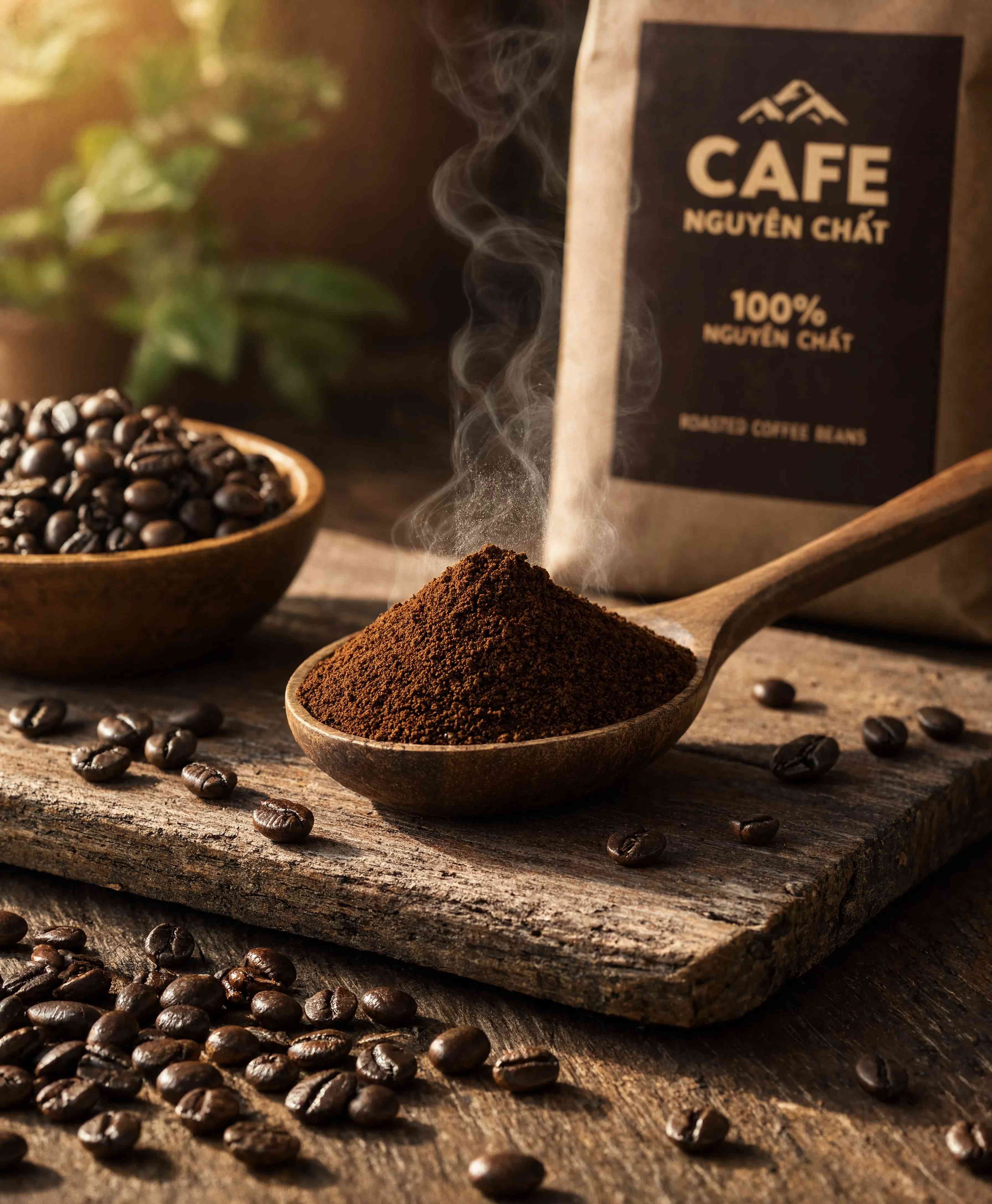
Sau công đoạn sấy, bột cà phê hòa tan vẫn chứa một lượng nước nhất định. Con số này thường được dùng như một chỉ tiêu kiểm soát, nhưng bản thân phần trăm độ ẩm không mô tả đầy đủ trạng thái của nước trong bột. Cùng một lượng nước tổng có thể tạo ra mức độ linh động khác nhau tùy thành phần và cấu trúc vật liệu. Vì vậy, đánh giá độ ổn định cần nhìn cả lượng nước và cách nước tương tác với nền bột.
Độ ẩm sau sấy nói lên điều gì?
Trong vật liệu thực phẩm khô, một phần nước liên kết tương đối chặt với các thành phần phân cực, trong khi phần nước linh động hơn có khả năng tham gia vào các quá trình vật lý và hóa học. Khi bột hút ẩm từ môi trường, nước có thể làm thay đổi trạng thái của nền vô định hình, tăng tính linh động phân tử và thúc đẩy các biến đổi không mong muốn. Đây là lý do cùng một mức độ ẩm danh nghĩa nhưng điều kiện bảo quản khác nhau có thể cho kết quả khác nhau.
Độ ẩm sau sấy còn liên quan đến cấu trúc hạt. Hạt có nhiều lỗ rỗng có thể trao đổi ẩm nhanh hơn hạt đặc. Nếu bột có diện tích bề mặt lớn, bao bì và điều kiện môi trường trở thành một phần của hệ kiểm soát. Một nghiên cứu về cà phê sấy bằng băng tải chân không cho thấy đặc tính hấp phụ của cà phê hòa tan có thể mô tả bằng đẳng nhiệt hấp phụ GAB, cho thấy sự tương tác giữa sản phẩm và hơi ẩm môi trường cần được xem xét trong thiết kế bảo quản.

Từ nước trong hạt đến nguy cơ kết tụ và biến đổi
Do đó, cùng một con số độ ẩm có thể dẫn đến hành vi khác nhau nếu cấu trúc hạt và trạng thái của nước trong nền bột khác nhau.
Khi độ ẩm tăng, bột có thể mất tính chảy, kết tụ hoặc thay đổi thời gian hòa tan. Một số biến đổi hóa học cũng có thể được thúc đẩy nếu nước làm tăng tính linh động của các chất phản ứng. Với cà phê, vấn đề còn liên quan đến sự suy giảm hương và thay đổi cảm quan. Do đó, giới hạn độ ẩm không nên chọn chỉ vì một con số thường được dùng trong ngành mà phải dựa trên dữ liệu ổn định của chính sản phẩm.
Để thiết lập giới hạn hợp lý, cần theo dõi mẫu ở nhiều mức độ ẩm và điều kiện nhiệt độ, độ ẩm tương đối. Các chỉ tiêu có thể gồm độ ẩm, hoạt độ nước, độ chảy, mức kết tụ, thời gian hoàn nguyên, màu, chất bay hơi hoặc đánh giá cảm quan. Khi các đường biến đổi được đặt cạnh nhau, có thể xác định vùng mà sản phẩm bắt đầu thay đổi nhanh thay vì chỉ đặt một giới hạn hành chính.
Xác lập giới hạn độ ẩm bằng dữ liệu ổn định
Độ ẩm cũng phụ thuộc vào phương pháp đo. Kết quả từ sấy tủ, thiết bị hồng ngoại hoặc phương pháp khác có thể không hoàn toàn tương đương nếu điều kiện đo khác nhau. Vì vậy, kiểm soát chất lượng cần chuẩn hóa phương pháp, nhiệt độ, thời gian và cách chuẩn bị mẫu. Nếu thay đổi phương pháp mà không kiểm tra tương quan, một thay đổi về số đo có thể bị hiểu nhầm là thay đổi của sản phẩm.
Bao bì là phần tiếp theo của bài toán. Bột khô có thể hút ẩm nếu vật liệu bao bì có độ cản hơi nước không đủ. Khi đó, việc giảm độ ẩm tại cuối dây chuyền chỉ giải quyết được một thời điểm. Dữ liệu ổn định phải được dùng để xác định tốc độ tăng ẩm theo thời gian và khả năng bảo vệ của bao bì trong điều kiện dự kiến.
Vì vậy, độ ẩm sau sấy nên được xem như một biến đầu vào của bài toán ổn định, không phải kết luận cuối cùng. Giá trị có ý nghĩa nhất khi được nối với hoạt độ nước, cấu trúc bột, bao bì và thời gian bảo quản. Cách tiếp cận này giúp phân biệt một bột có độ ẩm thấp nhưng dễ hút ẩm với một bột có trạng thái nước ổn định hơn trong cùng điều kiện môi trường.
Bao bì và nhiệt độ kho có thể làm thay đổi kết quả
Đường đẳng nhiệt hấp phụ là công cụ hữu ích để mô tả cách bột trao đổi ẩm với không khí. Khi biết quan hệ giữa độ ẩm cân bằng và độ ẩm tương đối, có thể dự báo xu hướng sản phẩm hút hoặc nhả nước trong điều kiện bảo quản. Điều này giúp lựa chọn bao bì dựa trên dữ liệu thay vì chỉ dựa vào độ ẩm ban đầu.
Một vấn đề khác là nhiệt độ kho. Cùng một bao bì và cùng độ ẩm ban đầu nhưng nhiệt độ khác nhau có thể làm tốc độ phản ứng hóa học và tốc độ di chuyển của nước thay đổi. Vì vậy, thử nghiệm ổn định nên có điều kiện nhiệt độ và độ ẩm được kiểm soát, đồng thời ghi rõ lịch sử mẫu.
Độ ẩm cũng liên quan đến độ bền của cấu trúc hạt sau khi đóng gói. Nếu nước làm nền vô định hình chuyển sang trạng thái linh động hơn, hạt có thể mềm và kết dính. Khi đó, vấn đề không chỉ là ngoại quan mà còn là khả năng định lượng, hòa tan và phân phối sản phẩm trong bao bì.
Một giới hạn tốt phải gắn với thuộc tính cần bảo vệ
Một giới hạn độ ẩm đáng tin cậy phải xuất phát từ điểm mà thuộc tính cần bảo vệ bắt đầu thay đổi vượt mức chấp nhận. Nếu sản phẩm vẫn ổn định ở một dải rộng, không cần thiết phải đặt giới hạn quá chặt vì điều đó làm tăng chi phí sấy mà không tạo thêm lợi ích tương ứng.
Có thể dùng thử nghiệm hấp phụ ẩm tăng tốc để xác định bao bì cần mức cản hơi nước nào. Mẫu được đặt ở độ ẩm tương đối kiểm soát và theo dõi khối lượng theo thời gian. Từ tốc độ tăng ẩm có thể ước tính mức thay đổi trong thời gian lưu trữ dự kiến.
Cũng cần phân biệt ổn định của bột với ổn định của toàn gói. Một bột có tính ổn định tốt khi để hở trong phòng thí nghiệm vẫn có thể suy giảm nhanh nếu bao bì có độ kín kém. Vì vậy, kiểm tra thành phẩm cuối nên mô phỏng cả điều kiện bao gói.
Tài liệu tham khảo
- Impact of Environmental Humidity on Instant Coffee Stability: Defining Moisture Thresholds for Quality Degradation and Shelf Life Prediction (2025), Foods, 14, 1826.
- Instant Coffee, ScienceDirect Topics, phần Storage and Stability.
- Peleg (2020), Humidity Caking and Its Prevention, Water Activity in Foods, Wiley.
- Alternative flexible plastic packaging for instant coffees (2023), Food Research International.
After the drying step, instant coffee powder still contains a certain amount of water. This number is usually used as a control indicator, but moisture percentage alone doesn't fully describe the state of water within the powder. The same total water amount can create different levels of mobility depending on composition and material structure. So assessing stability needs to look beyond a single percentage.
What does post-drying moisture tell you?
In dry food material, part of the water is bound relatively tightly to polar components, while more mobile water can take part in physical and chemical processes. When powder absorbs moisture from the environment, water can change the state of the amorphous matrix, increase molecular mobility, and promote unwanted changes.
Post-drying moisture also relates to particle structure. Highly porous particles can exchange moisture faster than dense particles. If the powder has large surface area, packaging and environmental conditions become part of the control system. A study on vacuum-belt-dried coffee showed instant coffee's sorption characteristics can be described using the GAB sorption isotherm.
From water in the particle to caking and change risk
So the same moisture number can lead to different behavior if particle structure and the state of water within the powder matrix differ.
As moisture rises, powder can lose flowability, cake, or change reconstitution time. Some chemical changes can also be accelerated if water increases the mobility of reactive species. For coffee, the issue also relates to aroma decline and sensory change. So a moisture limit shouldn't be chosen just because it's a commonly used number in the industry.
To set a reasonable limit, you need to track samples at multiple moisture levels and temperature/relative-humidity conditions. Indicators can include moisture, water activity, flowability, caking level, reconstitution time, color, volatile compounds, or sensory evaluation. When change curves are placed side by side, you can identify the region where the product starts changing rapidly instead of relying on a fixed number.
Establishing a moisture limit with stability data
Moisture also depends on the measurement method. Results from oven drying, infrared devices, or other methods may not be fully equivalent if measurement conditions differ. So quality control needs to standardize method, temperature, time, and sample preparation. If a method changes without checking the correlation, a change in the reading could be misinterpreted as a change in the product.
Packaging is the next part of the problem. Dry powder can absorb moisture if the packaging material's vapor barrier is inadequate. In that case, reducing moisture at the end of the line only solves the problem at one point in time. Stability data must be used to determine the rate of moisture increase over time and the packaging's protective ability under intended conditions.
So post-drying moisture should be seen as an input variable of the stability problem, not a final conclusion. It has the most meaning when linked to water activity, powder structure, packaging, and storage time. This approach helps distinguish a powder with low moisture but prone to absorbing moisture from one with more stable water state under the same environmental conditions.
Packaging and warehouse temperature can change the outcome
The sorption isotherm is a useful tool for describing how powder exchanges moisture with air. Knowing the relationship between equilibrium moisture and relative humidity lets you predict whether the product will tend to absorb or release water under storage conditions. This helps choose packaging based on data rather than relying only on initial moisture.
Another issue is warehouse temperature. The same packaging and same initial moisture but different temperature can change the rate of chemical reactions and the rate of water movement. So stability testing should have controlled temperature and humidity conditions, with sample history clearly recorded.
Moisture also relates to the strength of particle structure after packaging. If water turns the amorphous matrix more mobile, particles can soften and stick together. At that point, the issue isn't just appearance but also the ability to dose, dissolve, and distribute the product within the package.
A good limit needs to be tied to the attribute being protected
A trustworthy moisture limit needs to originate from the point where the attribute being protected starts changing beyond an acceptable level. If the product stays stable across a wide range, there's no need to set an overly tight limit, since that would increase drying cost without a corresponding benefit.
An accelerated moisture-sorption test can be used to determine what level of vapor barrier the packaging needs. Samples are placed at controlled relative humidity and mass is tracked over time. From the rate of moisture increase, you can estimate the level of change over the intended storage period.
You also need to distinguish powder stability from whole-package stability. A powder that's stable when left open in the lab can still decline quickly if the packaging has poor seal integrity. So final-product testing should also simulate packaging conditions.
References
- Impact of Environmental Humidity on Instant Coffee Stability: Defining Moisture Thresholds for Quality Degradation and Shelf Life Prediction (2025), Foods, 14, 1826.
- Instant Coffee, ScienceDirect Topics, Storage and Stability section.
- Peleg (2020), Humidity Caking and Its Prevention, Water Activity in Foods, Wiley.
- Alternative flexible plastic packaging for instant coffees (2023), Food Research International.